
When Donald Trump speaks bluntly about Greenland, the response is almost always the same. Commentators dismiss it as bombast, mock it as a real-estate fantasy, or react as if American troops are about to storm ashore and seize the island by force. That caricature, repeated endlessly in headlines and panel discussions, replaces serious analysis with theatrics and prevents any meaningful discussion of why Greenland actually matters. It misses the larger point. Greenland is not a punchline. It is one of the most strategically important pieces of territory on the planet, and Trump’s posture toward it reflects long-term thinking about security, power, and the prevention of future conflict. This is not about conquest. It is about recognizing an emerging danger early enough to deal with it through leverage, diplomacy, and economic alignment rather than through war.
Trump Knows Force Is Not the Answer
Trump understands that the United States cannot simply invade Greenland. Congress would block it, alliances would fracture, and the geopolitical cost would be enormous. That reality is obvious, and it is precisely why his rhetoric must be understood as strategic signaling rather than a literal threat of military action. Trump has said repeatedly that he does not want China or Russia as neighbors. That statement alone explains much of his approach. Greenland sits astride America’s northern approaches. Allowing rival powers to entrench themselves there would mean inviting long-term strategic pressure directly onto the United States itself.
Negotiation, Not Recklessness
Trump’s approach follows the same negotiating pattern he has described for decades, including in his book The Art of the Deal. It serves two distinct purposes. First, he opens with language that is intentionally expansive and provocative in order to seize the media cycle and force public engagement. In a crowded information environment, this guarantees attention and ensures the issue cannot be quietly ignored by bureaucracies, foreign governments, or the press. Second, by starting with demands that go beyond what he actually expects to secure, he creates room to later “concede” ground. When that happens, the other party walks away believing it has extracted a meaningful win, even though the final outcome aligns with Trump’s original objective. The result is a negotiation in which attention is captured, leverage is established, and agreement becomes possible without appearing as a retreat.
Greenland had largely disappeared from public consciousness. Without dramatic language, it would have remained that way, even as strategic threats quietly grew beneath the surface. Quiet diplomatic notes, policy papers, or closed-door briefings would never have penetrated the modern news cycle, which is driven by spectacle and controversy rather than long-term strategic analysis. In the absence of Trump’s blunt rhetoric, most Americans would still have no idea where Greenland sits on a map, let alone why it matters to U.S. national security.
Trump understands how attention works in the modern media environment. By using language that sounds shocking, even impossible, he forced Greenland into the headlines and onto the national radar. That accomplished the first and most necessary task: raising awareness inside the United States. Once the public understands that Greenland is not an icy curiosity but a strategic choke point tied to shipping lanes, military defense, and global power competition, serious policy discussion becomes possible. Awareness is the prerequisite for action.
The rhetoric also serves a third purpose. It puts China and Russia on notice. Trump has been explicit that he does not want either power as a neighbor. His words signal that Greenland is being watched and that attempts to gain a foothold there, whether through military posturing or so-called commercial development, will face resistance. In geopolitics, signaling matters. Clear, unmistakable signals can deter adversaries before they move too far, and Trump’s language removes any ambiguity about American intent.
Finally, the bombast sets the stage for negotiation in classic Trump fashion. Talk of “taking Greenland” is not a literal plan, but it shifts the bargaining range. It forces Denmark, Greenlandic leaders, and U.S. policymakers to confront questions they have long postponed: who is responsible for Greenland’s security, who will finance its future, and how outside powers will be kept out. Once those questions are unavoidable, negotiations can begin from a position of strength rather than complacency. In that sense, Trump’s rhetoric is not reckless. It is a calculated tool designed to wake everyone up, draw clear lines, and create the conditions for a negotiated solution before a far more dangerous crisis emerges.
Some of the reactions in Europe, including talk about “defending” Greenland or even Canada from the United States, are reactionary and reveal a lack of basic understanding of how American power actually functions. A U.S. president cannot unilaterally launch a military attack on allied territory. The American constitutional system forbids it. Congress controls the authorization of war, the funding of military operations, and the legal framework under which force can be used, and there is no plausible scenario in which Congress would approve an unprovoked attack on, and takeover of, a NATO ally or close partner. Interpreting Trump’s rhetoric as a literal invasion threat is an emotional reading rather than an intelligent one. It substitutes alarmism for analysis and distracts from the real issue, which is how to prevent hostile powers from exploiting strategically vital territory through foresight, deterrence, and negotiation rather than through conflict.
China’s Quiet Advance in Greenland
China’s interest in Greenland has never been accidental. Beijing prefers economic entry points that can later become strategic leverage. One of the most alarming moves was a Chinese company’s attempt to purchase an abandoned naval facility in Greenland, which would have given a Chinese state-linked entity access to port infrastructure in a region vital to U.S. security. That effort was blocked only after the U.S. strongly objected.
After that failure, China pivoted to infrastructure. Greenlandic leaders were courted with offers involving trade, seafood exports, and major construction projects. Among the most concerning proposals were plans to finance and build international airports in Greenland through Chinese state-backed banks. On the surface, these projects looked like development. In reality, they fit a well-documented pattern in which infrastructure loans become long-term leverage when small economies struggle to service the debt.
This is how China gains influence without firing a shot. Airports and ports are not neutral assets. They shape air access, shipping routes, and logistical capacity. If China gains control over them, even indirectly, it gains leverage over the territory itself. The fact that such projects had to be blocked through outside pressure exposes a serious weakness in how Greenland has been managed.
China’s ultimate objective is not partnership but dominance, and its methods are well established. Across South and Central America, Beijing has used debt, infrastructure financing, and commercial entanglement to gain leverage over ports, energy facilities, and transportation corridors that later translate into strategic control. The most striking example is the Panama Canal, where Chinese-linked firms secured influence over key port operations at both ends of the canal through long-term concessions, embedding themselves in one of the most critical chokepoints in global trade. Denmark showed the same naive vulnerability when it allowed China to probe for similar inroads in Greenland through infrastructure and commercial projects. That pattern is not coincidence. It is a warning, and Trump’s insistence on drawing a hard line is a response to that reality, not an overreaction to it.
Russia’s Militarization of the Arctic
Russia’s approach is far more overt. Moscow has been rebuilding Soviet-era Arctic bases, deploying advanced missile systems, and expanding a fleet of nuclear-powered icebreakers that allow year-round operations where others are limited by ice. Russia also asserts control over Arctic sea lanes, treating them as internal waters and demanding compliance from foreign vessels.
The geography makes this especially dangerous. The Greenland–Iceland–UK gap is one of the most critical maritime corridors in the world. It has long been central to monitoring Russian submarine movement into the Atlantic. As Russia expands its Arctic footprint, any weakness in Greenland’s security posture directly affects American and allied defense. Russian and Chinese expansionism in the Arctic is real and accelerating. Both have increased the use of military, coast guard, icebreaker, and dual-use research vessels across the region. Russia has rebuilt Arctic bases and patrols aggressively, while China deploys ships that serve strategic purposes, often alongside Russian forces. The core problem is that Denmark lacks the naval, air, and surveillance capacity to secure the region as activity grows, leaving Greenland increasingly vulnerable. Trump’s message is clear. He does not want China and Russia pressing against America’s northern flank while Europe debates and delays.
Denmark’s Limits and Misjudgments
Denmark simply does not have the resources to protect Greenland against great-power competition. Greenland is vast, sparsely populated, and extraordinarily expensive to secure. Denmark relies heavily on subsidies to sustain Greenland’s economy and public services, yet those subsidies do not translate into credible long-term security.
More troubling than the lack of resources has been a lack of strategic judgment. Denmark’s willingness, even temporarily, to entertain Chinese infrastructure involvement in Greenland demonstrates how easily economic pressure can override security concerns. That alone should raise alarms. Strategic territory cannot be managed on autopilot in a world where major powers are actively probing for openings.
Denmark’s Historical Treatment of Greenlanders
Greenland’s relationship with Denmark has also been fraught. For much of the twentieth century, Danish policy toward Greenland was openly paternalistic. Greenlanders were often treated as subjects rather than partners. Danish authorities imposed social engineering policies, disrupted traditional ways of life, and pursued assimilation programs that caused long-term cultural and social damage.
Perhaps the most notorious episode was the forced removal of Inuit children to Denmark in the mid-1900s in an attempt to “re-educate” them as Danish. Many were separated permanently from their families and culture, leaving deep scars that persist today. These are not ancient grievances. They shape Greenlandic political consciousness and fuel ongoing resentment toward rule from Copenhagen.
Greenland’s Right to Choose Its Future
Greenlanders have the right to declare independence, and many have expressed a desire for greater self-determination. The obstacle has never been political will alone. It has been economics. Greenland’s small population and limited tax base make full independence difficult without a reliable external partner.
That reality forces a practical question. If Greenland moves away from Danish governance, who is best positioned to provide security, investment, and long-term stability? The answer is not China, whose involvement would come with strings attached. It is not Russia, whose interests are overtly militarized. The United States is the closest, most capable, and most logical partner.
A Win for Greenland, America, and the World
American involvement in Greenland would not be colonial exploitation. Properly structured, it would mean investment, development, and security that benefit Greenlanders directly. Responsible development of Greenland’s natural resources would bring jobs, infrastructure, and revenue to a population that has long depended on external subsidies. It would also strengthen global supply chains and reduce dependence on hostile powers for critical materials. For the United States, it would mean securing a vital strategic position without firing a shot. For the world, it would mean stabilizing a region that is rapidly becoming central to global trade and security.
Preventing Tomorrow’s War Today
Trump’s approach to Greenland is not about ego. It is about foresight. Allowing China or Russia to entrench themselves economically or militarily in Greenland would create a future crisis far more dangerous than today’s diplomatic friction. By forcing the issue into the open now, Trump increases the chances that it can be resolved through negotiation, alignment, and investment rather than conflict.
That is what wise leadership looks like in an unstable world. It recognizes where the future is heading and acts early enough to shape it. Greenland is not a distraction. It is a warning, and Trump is right to take it seriously.
Shared Values and Europe’s Strategic Drift
Even if Denmark could secure Greenland, a deeper question remains: can a European power on a trajectory of radical political and cultural change be trusted to govern strategically vital territory in America’s hemisphere? Security alliances are not built on military hardware alone. They rest on shared values, shared assumptions about law, liberty, and national sovereignty. That foundation is eroding across much of Europe, and that erosion matters when deciding who should control strategically vital territory in the Western Hemisphere.
Across the European Union, free speech protections have been steadily weakened under the banner of “hate speech” enforcement. Governments increasingly criminalize political and religious expression that would remain protected in the United States. Christian speech, in particular, has been targeted, with pastors, activists, and public figures facing investigations, fines, and even police action for expressing traditional Christian beliefs. Recent actions within the European Union, including in Germany, are not isolated incidents but reflect a broader pattern of ideological enforcement against Christian expression.
In one highly publicized case, German police raided the home and church of a Christian pastor, physically assaulted him and broke his nose during the arrest, confiscated computers and church materials, and ransacked his property, only for the case to ultimately collapse without charges. Incidents like this are no longer anomalies; they illustrate how state power in parts of Europe is increasingly being used to police speech and belief rather than to protect civil liberties. Denmark operates within this same EU legal and cultural framework and has its own record of restricting Christian expression through hate-speech laws and speech regulations, raising legitimate concerns about whether European governments still share the foundational commitments to free expression and religious liberty that once aligned them closely with the United States.
At the same time, Europe’s uncontrolled immigration policies are reshaping entire societies. Demographic trends suggest that several EU countries, and possibly the United Kingdom, could face profound cultural and political transformation within the next fifty years, or sooner. In some cases, parallel legal and social systems are already emerging, raising serious questions about long-term stability, civil liberties, and the future of Western constitutional norms.
These developments directly affect strategic trust. When allied governments move away from free speech, suppress religious expression, and allow demographic changes that undermine national cohesion, the assumption of shared long-term interests becomes weaker. From an American perspective, relying on such governments to steward territory that directly affects U.S. homeland security becomes increasingly risky.
This is not hostility toward Europe. It is realism. Strategic planning must account for cultural and political trajectories, not just present-day alliances. Greenland’s importance is too great to be treated as an afterthought, especially when the governing power over it is part of a broader European system drifting away from the principles that once anchored transatlantic trust.
In the end, the controversy over Greenland is not about Donald Trump’s tone, but about whether the United States is willing to think ahead in a world that is becoming more dangerous and less forgiving. Greenland sits at the intersection of great-power competition, emerging trade routes, resource security, and homeland defense, and pretending otherwise only invites future crisis. Trump’s approach recognizes that once hostile powers entrench themselves, peaceful options disappear. By forcing attention now, drawing clear lines, and pushing allies and adversaries alike to confront uncomfortable realities, he is attempting to shape events before they harden into conflict. That is not recklessness. It is strategic foresight, and history has shown that nations that act early, while choices still exist, are far more likely to preserve peace than those that wait until they no longer do.
Return to Christian Politics and Current Events Page
Have a Question or Insight? Join the Discussion — To Comment, Scroll to the Bottom. Please Be Courteous and Stay on Topic.
Books by Mark Swarbrick
 For more information on Jimmy Swaggart Ministries, get my book, Swaggartism: The Strange Doctrines of Jimmy Swaggart Ministries, available now on Amazon in paperback, Kindle eBook, and audio book, starting at only $6.99. For information click HERE.
Available in Paperback and Kindle eBook – 266 pages of documented facts!
For more information on Jimmy Swaggart Ministries, get my book, Swaggartism: The Strange Doctrines of Jimmy Swaggart Ministries, available now on Amazon in paperback, Kindle eBook, and audio book, starting at only $6.99. For information click HERE.
Available in Paperback and Kindle eBook – 266 pages of documented facts!


 Seventh-Day Adventism Examined: A Concise Summary of Adventism's Unbiblical Doctrines
Author Mark Swarbrick meticulously dissects the myriad of false teachings within Adventism, contrasting these interpretations with scriptural truth.
Available in Paperback, Kindle eBook, and Audio Book. Only $3.99 - Click HERE to purchase at Amazon.
Seventh-Day Adventism Examined: A Concise Summary of Adventism's Unbiblical Doctrines
Author Mark Swarbrick meticulously dissects the myriad of false teachings within Adventism, contrasting these interpretations with scriptural truth.
Available in Paperback, Kindle eBook, and Audio Book. Only $3.99 - Click HERE to purchase at Amazon.
 The Pre-Trib Rapture: Biblical Truth of the Blessed Hope
In his book, The Pre-Trib Rapture, author Mark Swarbrick meticulously outlines the extensive biblical support for a Pre-Trib Rapture, emphasizing the deliverance of the Church before the onset of the impending Tribulation period.
Available in Paperback, Kindle eBook, and Audio Book. Only $3.99 - Click HERE to purchase at Amazon.
The Pre-Trib Rapture: Biblical Truth of the Blessed Hope
In his book, The Pre-Trib Rapture, author Mark Swarbrick meticulously outlines the extensive biblical support for a Pre-Trib Rapture, emphasizing the deliverance of the Church before the onset of the impending Tribulation period.
Available in Paperback, Kindle eBook, and Audio Book. Only $3.99 - Click HERE to purchase at Amazon.
 Hidden History: The Untold Story of the Democratic Party
The political narrative in America has transcended the realm of politics to become a battle between the forces of good and evil. It is essential that all Christians are informed on the anti-Christian direction of the Democratic Party.
200 pages of factual history! Available in Paperback, Kindle eBook, and Audio Book. Only $3.99 - Click HERE to purchase at Amazon.
Hidden History: The Untold Story of the Democratic Party
The political narrative in America has transcended the realm of politics to become a battle between the forces of good and evil. It is essential that all Christians are informed on the anti-Christian direction of the Democratic Party.
200 pages of factual history! Available in Paperback, Kindle eBook, and Audio Book. Only $3.99 - Click HERE to purchase at Amazon.
 The Covid Conspiracy: The Cure for Covid and the Plot to Hide it from the World
The Covid Conspiracy tells the incredible story of diabolical collusion between multinational drug companies, governmental regulatory agencies, and unscrupulous politicians.
Available in Paperback, Kindle eBook, and Audio Book. Only $2.99 - Click HERE to purchase at Amazon.
The Covid Conspiracy: The Cure for Covid and the Plot to Hide it from the World
The Covid Conspiracy tells the incredible story of diabolical collusion between multinational drug companies, governmental regulatory agencies, and unscrupulous politicians.
Available in Paperback, Kindle eBook, and Audio Book. Only $2.99 - Click HERE to purchase at Amazon.
 The Carnivore Diet: The Science, the Promise, and the Pitfalls
Author Mark Swarbrick thoroughly explains the diet, telling of his experiences with it and how it has radically improved his health in a short amount of time. One chapter deals with the current war on meat and what the Bible has to say about those who forbid eating meat.
Available in Paperback, Kindle eBook, and Audio Book. Only $2.99 - Click HERE to purchase at Amazon.
The Carnivore Diet: The Science, the Promise, and the Pitfalls
Author Mark Swarbrick thoroughly explains the diet, telling of his experiences with it and how it has radically improved his health in a short amount of time. One chapter deals with the current war on meat and what the Bible has to say about those who forbid eating meat.
Available in Paperback, Kindle eBook, and Audio Book. Only $2.99 - Click HERE to purchase at Amazon.
 Heavenly Miracles: True Stories of Supernatural Intervention
When the author saw how demons flee at the name of Jesus, his growing faith resulted in numerous miracles in his life and ministry.
Available in Paperback, Kindle eBook, and Audio Book. Only $2.99 - Click HERE to purchase at Amazon.
Heavenly Miracles: True Stories of Supernatural Intervention
When the author saw how demons flee at the name of Jesus, his growing faith resulted in numerous miracles in his life and ministry.
Available in Paperback, Kindle eBook, and Audio Book. Only $2.99 - Click HERE to purchase at Amazon.
 King James Onlyism: Is the KJV the Best Bible Version?
KJV Onlyists have troubled the hearts of many a Christianand have split churches in half. Controversy, factions, and strive are their forte. No doubt, they are sincere, but they are sincerely wrong.
Available in Paperback, Kindle eBook, and Audio Book. Only $2.99 - Click HERE to purchase at Amazon.
King James Onlyism: Is the KJV the Best Bible Version?
KJV Onlyists have troubled the hearts of many a Christianand have split churches in half. Controversy, factions, and strive are their forte. No doubt, they are sincere, but they are sincerely wrong.
Available in Paperback, Kindle eBook, and Audio Book. Only $2.99 - Click HERE to purchase at Amazon.

 The Hidden Truth about Catholicism
If you are a Catholic this book is for you. With loving respect, this book gives a detailed account of the history of Catholicism with an in-depth analysis of Catholic teachings.
Available in Paperback, Kindle eBook, and Audio Book. Only $2.99 - Click HERE to purchase at Amazon.
The Hidden Truth about Catholicism
If you are a Catholic this book is for you. With loving respect, this book gives a detailed account of the history of Catholicism with an in-depth analysis of Catholic teachings.
Available in Paperback, Kindle eBook, and Audio Book. Only $2.99 - Click HERE to purchase at Amazon.
 Life after Death: What Happens When We Die?
A refutation of soul sleep, the idea that people are unconscious or nonexistent until God raises their bodies from the dead at the resurrection.
Available in Paperback, Kindle eBook, and Audio Book. Only $2.99 - Click HERE to purchase at Amazon.
Life after Death: What Happens When We Die?
A refutation of soul sleep, the idea that people are unconscious or nonexistent until God raises their bodies from the dead at the resurrection.
Available in Paperback, Kindle eBook, and Audio Book. Only $2.99 - Click HERE to purchase at Amazon.
 Mormonism Examined: The Bizarre History and Unbiblical Doctrines of Mormonism
This is not an anti-Mormon rant, but a thoughtful analysis of Mormonism in the light of the Holy Bible and historic Christian doctrine.
Available in Paperback, Kindle eBook, and Audio Book. Only $4.99 - Click HERE to purchase at Amazon.
Mormonism Examined: The Bizarre History and Unbiblical Doctrines of Mormonism
This is not an anti-Mormon rant, but a thoughtful analysis of Mormonism in the light of the Holy Bible and historic Christian doctrine.
Available in Paperback, Kindle eBook, and Audio Book. Only $4.99 - Click HERE to purchase at Amazon.
 Truly Amazing: The Real Story of Adam and Eve
Children get bombarded with confusion about gender, marriage, and evolution at a very young age.This book shows what God has to say on these crucial matters. This book is a creation story for kids that explains the creation and the fall in an interesting way that children can relate to.
Available in Paperback, Kindle eBook, and Audio Book. Only $2.99 - Click HERE to purchase at Amazon.
Truly Amazing: The Real Story of Adam and Eve
Children get bombarded with confusion about gender, marriage, and evolution at a very young age.This book shows what God has to say on these crucial matters. This book is a creation story for kids that explains the creation and the fall in an interesting way that children can relate to.
Available in Paperback, Kindle eBook, and Audio Book. Only $2.99 - Click HERE to purchase at Amazon.
 Global Warming: Socialism in Disguise
In "Global Warming Examined," Mark Swarbrick compellingly illustrates how genuine scientific data contradicts the prevalent political narrative of an imminent climate crisis. Drawing on insights from esteemed scientists, he dismantles the fallacious belief in man-made global warming as a cataclysmic threat.
Available in Paperback, Kindle eBook, and Audio Book. Only $3.99 - Click HERE to purchase at Amazon.
Global Warming: Socialism in Disguise
In "Global Warming Examined," Mark Swarbrick compellingly illustrates how genuine scientific data contradicts the prevalent political narrative of an imminent climate crisis. Drawing on insights from esteemed scientists, he dismantles the fallacious belief in man-made global warming as a cataclysmic threat.
Available in Paperback, Kindle eBook, and Audio Book. Only $3.99 - Click HERE to purchase at Amazon.
 Beyond Redemption: Love and Longing in the Old West (Book 1)
A thrilling historical western and romance packed with Gospel truth. A perfect gift for someone you want to share the Gospel with. Here is what one reader said about Beyond Redemption:
“THIS READ IS A GRIPPING JOURNEY back in time to the rugged Wild West, where love, justice, and redemption entwine in a tale that will leave you captivated. Author Mark Swarbrick skillfully weaves historical detail into this action-packed narrative, giving readers an authentic and suspenseful experience. The story revolves around Cal Chandler, an unlikely outlaw forced into a life of crime, and his love for Jessica Lorena McKenzie, a devout Christian, creating a captivating clash of faiths and emotions. For fans of historical depth, “Beyond Redemption” is a must-read that brings the people of the Wild West to life as they truly were." — Jerry Rubenstein
Beyond Redemption: Love and Longing in the Old West (Book 1)
A thrilling historical western and romance packed with Gospel truth. A perfect gift for someone you want to share the Gospel with. Here is what one reader said about Beyond Redemption:
“THIS READ IS A GRIPPING JOURNEY back in time to the rugged Wild West, where love, justice, and redemption entwine in a tale that will leave you captivated. Author Mark Swarbrick skillfully weaves historical detail into this action-packed narrative, giving readers an authentic and suspenseful experience. The story revolves around Cal Chandler, an unlikely outlaw forced into a life of crime, and his love for Jessica Lorena McKenzie, a devout Christian, creating a captivating clash of faiths and emotions. For fans of historical depth, “Beyond Redemption” is a must-read that brings the people of the Wild West to life as they truly were." — Jerry Rubenstein
Available in Paperback, Kindle eBook, and Audio Book. Only $6.99 - Click HERE to purchase at Amazon.
 Beyond Redemption: War & Peace in the Old West (Book 2)
The Second Book in the Beyond Redemption series. How the characters prayerfully deal with their challenges is a testament to the changing power of the Gospel of Jesus Christ.
Available in Paperback, Kindle eBook, and Audio Book. Only $9.99 - Click HERE to purchase.
Beyond Redemption: War & Peace in the Old West (Book 2)
The Second Book in the Beyond Redemption series. How the characters prayerfully deal with their challenges is a testament to the changing power of the Gospel of Jesus Christ.
Available in Paperback, Kindle eBook, and Audio Book. Only $9.99 - Click HERE to purchase.
 Abducted by Demons - Saved by Jesus: My Journey for Hell to Heaven
Join Mark Swarbrick on a heart-wrenching journey from the depths of demonic oppression to the transformative peace and salvation found in Christ.
Available in Paperback, Kindle eBook, and Audio Book. Only $3.99 - Click HERE to purchase at Amazon.
Abducted by Demons - Saved by Jesus: My Journey for Hell to Heaven
Join Mark Swarbrick on a heart-wrenching journey from the depths of demonic oppression to the transformative peace and salvation found in Christ.
Available in Paperback, Kindle eBook, and Audio Book. Only $3.99 - Click HERE to purchase at Amazon.
 Fossil Fuels – God’s Gift to Man: How God used Coal, Oil, and Natural Gas to Save Mankind
In this eye-opening book, Mark Swarbrick challenges the prevailing narrative surrounding fossil fuels and climate change, showing that coal, oil, and natural gas are not environmental villains, but rather divine provisions strategically placed by God to sustain humanity's growing population.
Available in Paperback, Kindle eBook, and Audio Book. Only $3.99 - Click HERE to purchase.
Fossil Fuels – God’s Gift to Man: How God used Coal, Oil, and Natural Gas to Save Mankind
In this eye-opening book, Mark Swarbrick challenges the prevailing narrative surrounding fossil fuels and climate change, showing that coal, oil, and natural gas are not environmental villains, but rather divine provisions strategically placed by God to sustain humanity's growing population.
Available in Paperback, Kindle eBook, and Audio Book. Only $3.99 - Click HERE to purchase.
 Word of Faith Examined: A Refutation of the Prosperity Gospel's Unbiblical Doctrines
In this bold and timely book, pastor and author Mark Swarbrick exposes the dangers and distortions at the heart of the Word of Faith movement, also known as the “Name-it-and-Claim-it” or “Health and Wealth Gospel.”
Available in Paperback, Kindle eBook, and Audio Book. Only $3.99 - Click HERE to purchase.
Word of Faith Examined: A Refutation of the Prosperity Gospel's Unbiblical Doctrines
In this bold and timely book, pastor and author Mark Swarbrick exposes the dangers and distortions at the heart of the Word of Faith movement, also known as the “Name-it-and-Claim-it” or “Health and Wealth Gospel.”
Available in Paperback, Kindle eBook, and Audio Book. Only $3.99 - Click HERE to purchase.
 The Israel of God: A Christian and Biblical Perspective of the Modern State of Israel
Author Mark Swarbrick delivers a clear, biblically grounded exploration of Israel’s unique place in God’s redemptive plan—past, present, and future.
Available in Paperback, Kindle eBook, and Audio Book. Only $3.99 – Click HERE to purchase at Amazon.
The Israel of God: A Christian and Biblical Perspective of the Modern State of Israel
Author Mark Swarbrick delivers a clear, biblically grounded exploration of Israel’s unique place in God’s redemptive plan—past, present, and future.
Available in Paperback, Kindle eBook, and Audio Book. Only $3.99 – Click HERE to purchase at Amazon.
 Extraterrestrials Exposed: The Scientific and Biblical Evidence of a Grand Deception
Drawing on extensive research, author Mark Swarbrick uncovers how claims of alien encounters, UFO sightings, and government disclosures may not be what they seem. He presents a thought-provoking analysis that combines scientific inquiry with biblical teachings, suggesting that what many perceive as alien phenomena could actually be a sophisticated ruse designed to mislead humanity.
Available in Paperback, Kindle eBook, and Audio Book. Only $2.99 – Click
HERE
to purchase at Amazon.
Extraterrestrials Exposed: The Scientific and Biblical Evidence of a Grand Deception
Drawing on extensive research, author Mark Swarbrick uncovers how claims of alien encounters, UFO sightings, and government disclosures may not be what they seem. He presents a thought-provoking analysis that combines scientific inquiry with biblical teachings, suggesting that what many perceive as alien phenomena could actually be a sophisticated ruse designed to mislead humanity.
Available in Paperback, Kindle eBook, and Audio Book. Only $2.99 – Click
HERE
to purchase at Amazon.
 Socialism Examined: Man's Secular Answer to a Spiritual Problem
Author Mark Swarbrick explains, in simple terms, why socialism conflicts with biblical truth and why it consistently harms the very people it claims to help. You will learn how modern political leaders use fear, crisis, and entitlement to push a country toward greater state control — and why many don’t recognize it until it’s too late.
Available in Paperback, Kindle eBook, and Audio Book. Only $3.99 – Click
HERE
to purchase at Amazon.
Socialism Examined: Man's Secular Answer to a Spiritual Problem
Author Mark Swarbrick explains, in simple terms, why socialism conflicts with biblical truth and why it consistently harms the very people it claims to help. You will learn how modern political leaders use fear, crisis, and entitlement to push a country toward greater state control — and why many don’t recognize it until it’s too late.
Available in Paperback, Kindle eBook, and Audio Book. Only $3.99 – Click
HERE
to purchase at Amazon.
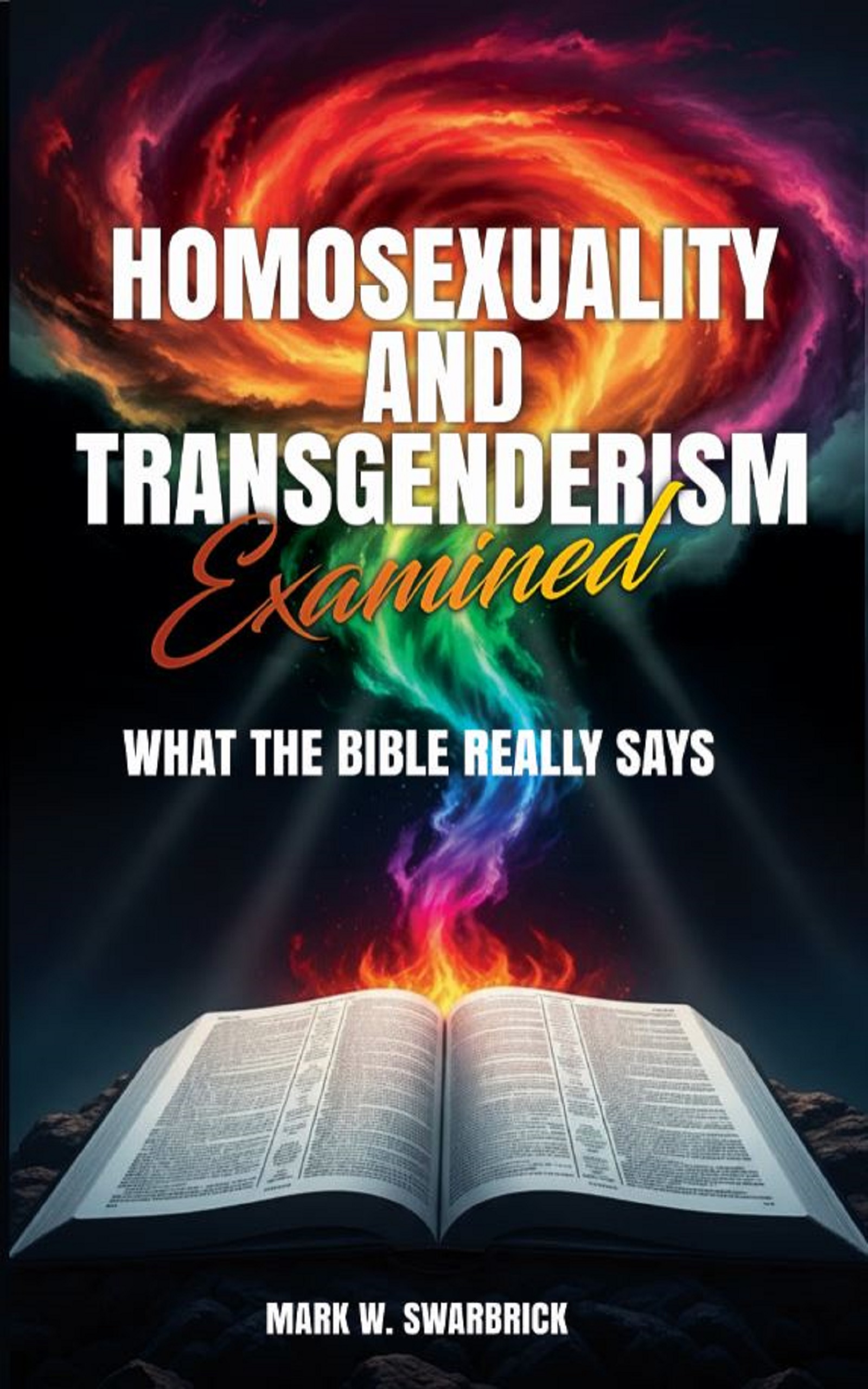 Homosexuality and Trangenderism Examined: What the Bible Really Says
Author Mark Swarbrick covers the key biblical passages on homosexuality and transgenderism, showing what Scripture teaches and how those teachings shaped Western moral order for nearly two millennia before being rejected in our time.
Available in Paperback, Kindle eBook, and Audio Book. Only $3.99 – Click
HERE
to purchase at Amazon.
Homosexuality and Trangenderism Examined: What the Bible Really Says
Author Mark Swarbrick covers the key biblical passages on homosexuality and transgenderism, showing what Scripture teaches and how those teachings shaped Western moral order for nearly two millennia before being rejected in our time.
Available in Paperback, Kindle eBook, and Audio Book. Only $3.99 – Click
HERE
to purchase at Amazon.
