
Are prayers to the saints biblical? Roman Catholicism teaches believers to pray to Mary and other departed saints and ask for their intercession. But the New Testament consistently directs believers to pray to God, through Jesus Christ, and nowhere instructs Christians to address prayers to deceased believers. The biblical question is therefore not whether Catholics sincerely practice prayer to the saints, but whether Scripture authorizes the practice.
Roman Catholic priest Dan Reehil has publicly defended praying to departed saints by appealing to Revelation 5:8, the Church Fathers, the Transfiguration, and the angel Gabriel’s appearance to Mary. This article examines those arguments from Scripture and history, including whether prayer is an act of worship and whether attempting to communicate with the dead falls under the biblical prohibition against consulting the dead.
This article addresses one of Dan Reehil’s videos in which he encourages prayer to the spirits of the deceased rather than to God. Sadly, many people have been deceived by this teaching. It is difficult to understand why anyone would seek spiritual instruction from a Roman Catholic priest. The Roman Catholic Church now permits the blessing of same-sex unions, thereby affirming what God condemns as sin. A church that blesses sexual immorality has departed from biblical truth and is an apostate church. Believers should not receive doctrinal instruction from a man who serves as a priest in such a church. With that in mind, let us compare Dan Reehil’s teaching about praying to the dead with what the Bible says.

If you are enjoying this article, you would love my book!
The Hidden Truth About Catholicism
Author Mark Swarbrick delivers a clear, biblically grounded exploration of the false teachings of the Roman Catholic Church.
Available in Paperback, Kindle eBook, and Audio Book. Only $4.99.
Does Revelation 5:8 Support Prayers to the Saints?
In one of his videos, he begins by quoting Revelation 5:8: “The twenty-four elders fell down before the Lamb, each holding a harp, and golden bowls full of incense, which are the prayers of the saints.” From this passage he attempts to defend the unbiblical and idolatrous practice of praying to dead people. However, nothing in the context indicates that these prayers were made to these twenty-four elders or that the elders even knew what the prayers were for or who made them.
Get The Great Apostasy – Pastor Mark’s 307 page definitive work on Catholicism!
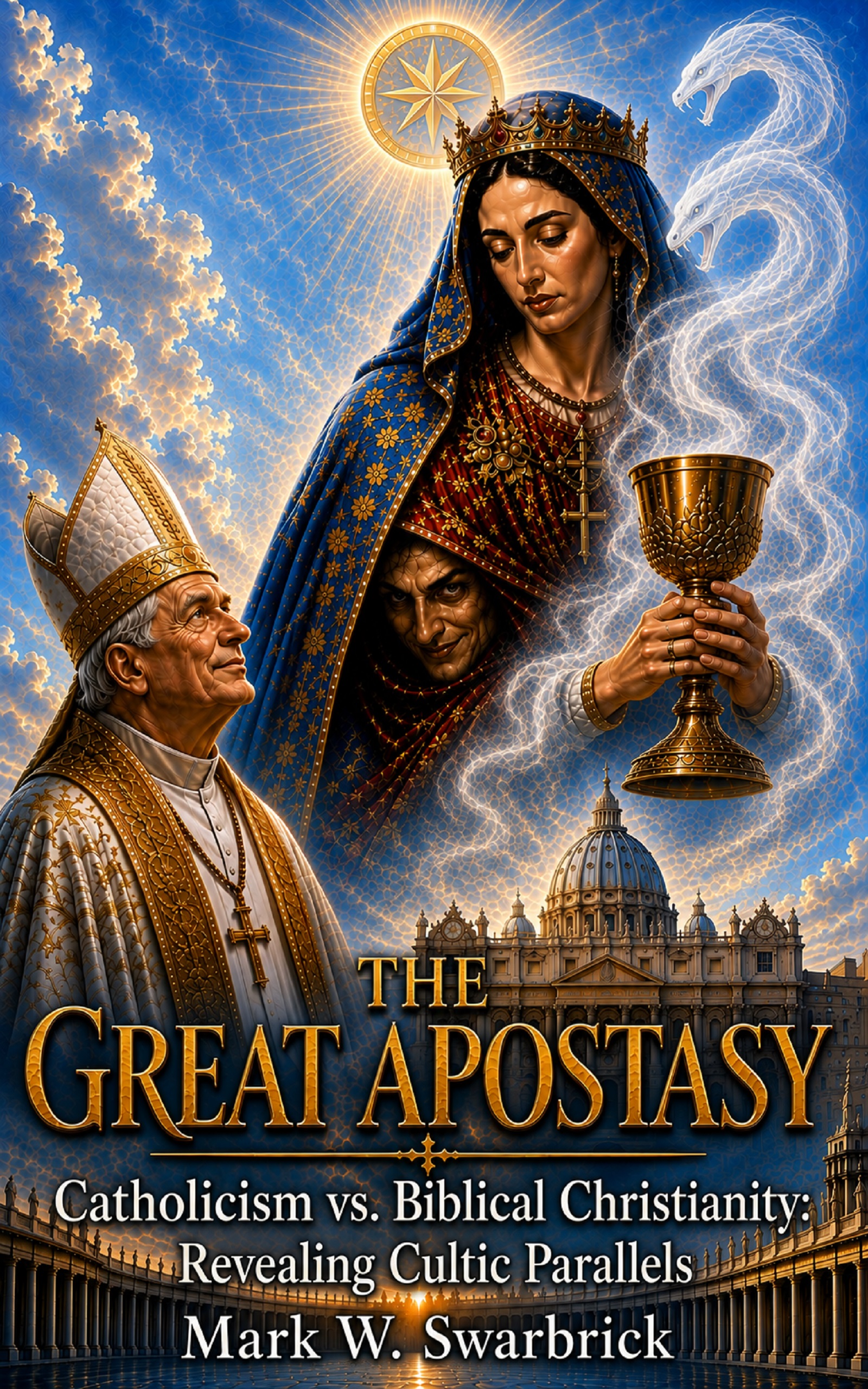
The Great Apostasy: Catholicism vs. Biblical Christianity
Drawing extensively from Catholicism’s own official writings, Swarbrick examines the papacy, Mary, purgatory, the priesthood, salvation by works, transubstantiation, confession, tradition, religious persecution, and much more. Doctrine by doctrine, he compares the teachings of Rome with Scripture and builds the case that Catholicism bears the defining marks of a non-Christian cult.
Available in Paperback, Hardback, Kindle eBook, and Audio Book. Only $4.99.
Buy Now on Amazon
The prayers of Christians go immediately and directly God. God Himself invites us to pray directly to Him: “Call to Me and I will answer you, and will tell you great and hidden things that you have not known” (Jeremiah 33:3). God is omniscient. The Bible teaches that God knows everything about us. As David wrote, “You perceive my thoughts from afar” (Psalm 139:2). He also declared, “Even before a word is on my tongue, behold, O LORD, you know it altogether” (Psalm 139:4). Later in the same psalm he wrote, “If I make my bed in Sheol, You are there” (Psalm 139:8), emphasizing that there is no place where we can escape God’s presence or His perfect knowledge of us. Jesus likewise taught that God knows us so completely that “even the hairs of your head are all numbered” (Matthew 10:30).
Nothing about us is hidden from God. He knows our thoughts, our words, our needs, our whereabouts, and even the smallest details of our lives before we ever speak a prayer. In view of these truths, the idea that angels or the spirits of the dead are needed to carry our prayers to God is without merit. The priest’s interpretation cannot be reconciled with the biblical doctrine of God’s omniscience. It imagines that God must first be informed by saints in heaven that someone has prayed before He can answer those prayers.
The New Testament leaves no doubt about where the Christian’s prayers should be directed. Jesus taught His disciples to pray, “Our Father who art in heaven” (Matthew 6:9), and promised, “My Father will give you whatever you ask in My name” (John 16:23). Through Christ’s death and resurrection, every believer now has direct access to God. As Paul declares, “For through Him we both have access to the Father by one Spirit” (Ephesians 2:18). Because of this, Hebrews 4:16 invites us to “approach the throne of grace with confidence,” not through angels, departed believers, or any other intermediary, but through Jesus Christ Himself. Scripture also declares, “there is one God and one mediator between God and mankind, the man Christ Jesus” (1 Timothy 2:5). While Revelation 5:8 portrays the prayers of the saints as precious before God, it does not teach that believers should pray to deceased saints or seek their intercession. Christ alone is our Mediator, and through Him every child of God has immediate, unhindered access to the Father.
The Actual Meaning of Revelation 5:8 in Context
The Catholic priest’s interpretation fails on two other counts. First, nothing in the passage says that believers should direct their prayers to angels or to the dead. Second, it completely ignores the context. Revelation chapter 5 is not about how to pray. Rather, it depicts events in heaven immediately after the Rapture of the church (which occurs at Revelation 4:1) and during the Tribulation, when God’s wrath is poured out on the earth. The context centers on the scroll containing the seven seals, seven trumpets, and seven bowls, all of which represent God’s judgment on a world that has turned against Him.
This passage is highly symbolic. The twenty-four elders represent the Church in heaven after the Rapture while new Christian converts on earth are being persecuted by the Antichrist and a godless world. Prayers for deliverance and justice that were received directly by God are symbolically pictured as being placed on the golden altar before His throne along with incense. Then, in Revelation 8:3–5, an angel takes “the censer, filled it with fire from the altar, and threw it on the earth, and there were peals of thunder, rumblings, flashes of lightning, and an earthquake.” Thus begins the horrors of God’s Tribulation wrath upon the earth, which is described throughout the remainder of the book of Revelation.
The point of the symbolism is to demonstrate the solidarity between heaven and believers on earth during the Tribulation and to show that the time is close at hand for God to answer their prayers for deliverance and justice. Why are the prayers symbolically pictured as being hurled down upon the earth? Why are they immediately followed by peals of thunder, rumblings, flashes of lightning, and an earthquake? The answer is found in the symbolism itself. The thunder, lightning, and earthquake signify the coming wrath of God, while the prayers of the saints, symbolically hurled down upon the earth, signify that God is now answering those prayers by pouring out His Tribulation judgments upon a rebellious world.
The passage also reveals the direction in which the prayers are traveling. It shows the saints holding two things: harps and golden bowls full of incense. Where did they get these items? From God, of course. Where else? The Bible says, “Every good and perfect gift is from…the Father” (James 1:17). The golden bowls of incense are identified as the prayers of the Tribulation saints. Therefore, the prayers went directly from the Tribulation saints to God, and from there to the saints in heaven. The heavenly saints witness the incense ascending before God, illustrating that the time is at hand for the fulfillment of those prayers. But the priest’s interpretation turns the entire passage on its head by claiming that the prayers first went to the saints, who then have to help God out by transferring the prayers to Him. This is the exact opposite of what the text portrays—the prayers go directly to God, after which God gives them to the saints.
Most damning to the priest’s contention is this: nothing in this passage instructs believers to pray to the spirits of deceased saints or to angels. Such an interpretation is not exegesis but eisegesis—a Catholic priest attempting to impose Catholic dogma upon the Scriptures.
Did the Early Church Pray to the Saints?
After this mutilation of Holy Scripture, the priest turns to cherry-picking doctrines from the writings of some of the later Church Fathers. While these writings are historically valuable, they are not the inspired, infallible Word of God as the Bible is. Like all uninspired writings, they contain both valuable insights and false teachings. Therefore, they must always be tested by the authority of Scripture, not the other way around.
If, instead of cherry-picking isolated quotations, we examine the writings of the Church Fathers as a whole, a very different picture emerges. The writings of the earliest Church Fathers provide no support for the Catholic practice of praying to departed saints. In fact, the earliest Christian treatises devoted specifically to prayer consistently direct believers to pray to God the Father through Jesus Christ. Tertullian (c. A.D. 160–220) expounds the Lord’s Prayer and instructs Christians to pray as Jesus taught. Origen (c. A.D. 185–253) repeatedly teaches that prayer is to be addressed to the Father through the Son. Likewise, Cyprian (d. A.D. 258) follows Christ’s instruction that believers are to pray, “Our Father.” None of these early writers instruct Christians to pray to departed saints or to seek their intercession.
This silence is significant. If praying to deceased saints had been an apostolic practice, it is difficult to explain why the earliest and most influential teachers of the Church never mention it when writing entire treatises on prayer. Praying to saints was unknown during the apostolic age and for centuries afterward. The earliest evidence of Christians actually addressing prayers to departed saints does not appear until the fourth century, when the practice gradually became widespread. The historical record therefore supports the New Testament pattern: believers have direct access to the Father through Jesus Christ and have no need for additional heavenly mediators.
Even after the practice became widespread, it was not without opposition. Around A.D. 400, Vigilantius openly rejected prayers to departed saints and the veneration of relics. Had these practices truly originated with the apostles, it is difficult to imagine a respected Christian leader publicly rejecting them only three centuries later. Instead, the historical evidence points in the opposite direction. The earliest Christian writers consistently taught believers to pray directly to God through Jesus Christ, while the practice of praying to departed saints arose centuries later as a post-apostolic development.
In this regard, it must be pointed out that Dan Reehil makes a historical claim for which there is absolutely no evidence. Reehil falsely claims, without any historical evidence, that second-century Christians gathered at Polycarp’s tomb and asked for his prayers. The only surviving manuscript describing what occurred after Polycarp’s martyrdom is The Martyrdom of Polycarp. That document records that the believers recovered Polycarp’s bones, buried them in a suitable place, and gathered there annually to commemorate his martyrdom and encourage one another by his faithful example. It says absolutely nothing about praying to Polycarp or asking for his intercession. Reehil’s claim is therefore not based on the historical record. It is a fabrication, invented out of whole cloth to support a doctrine that the document itself never teaches.
Does the Transfiguration Support Praying to Saints?
The priest next appeals to Christ’s conversation with Moses and Elijah at the Transfiguration (Matthew 17:1–8; Mark 9:2–8; Luke 9:28–36) as justification for praying to departed saints. This argument fails for several reasons.
First, Jesus Christ is the eternal Son of God. As such, He was permitted to do things that ordinary believers are not. He accepted worship (Matthew 14:33; John 9:38), forgave sins by His own authority (Mark 2:5–12), declared Himself Lord of the Sabbath (Mark 2:28), cleansed the temple by overturning the tables of the money changers and driving them out with a whip (John 2:13–17), and stated that He could call upon His Father to send more than twelve legions of angels (Matthew 26:53). Simply because Christ did something does not mean His followers are authorized to do the same. Christian doctrine is established by what Scripture commands believers to do, not by assuming that every unique act of Christ is a pattern for us to imitate.
Second, Jesus did not pray to Moses or Elijah. He did not petition them, ask them for help, or request that they present His prayers to the Father. Luke tells us exactly what occurred: Moses and Elijah “appeared in glory and spoke of his departure, which he was about to accomplish at Jerusalem” (Luke 9:31). They discussed Christ’s impending death, burial, resurrection, and ascension—the central event in God’s plan of redemption. This was a divinely appointed conversation, not an act of prayer.
Third, the entire event was initiated by God, not by man. Jesus did not attempt to contact the dead, nor did the disciples summon Moses or Elijah. God Himself caused Moses and Elijah to appear for His own purposes. There is a vast difference between God sovereignly allowing departed saints to appear and human beings attempting to communicate with them.
Fourth, the conclusion of the Transfiguration completely undermines the priest’s argument. As Peter suggested placing Moses, Elijah, and Jesus on equal footing by building three shelters, the Father interrupted him, declaring, “This is my beloved Son…listen to Him!” (Matthew 17:5). Then the vision ended, and “they saw no one but Jesus only” (Matthew 17:8). The Father’s command was not to seek Moses or Elijah but to listen to His Son.
If the priest’s interpretation were correct, we would expect the apostles to teach believers to pray to departed saints after witnessing the Transfiguration. They never did. Throughout the New Testament they consistently direct believers to pray to the Father through Jesus Christ. The priest has once again read a doctrine into the text that simply is not there. The Transfiguration provides no biblical support whatsoever for praying to departed saints. Instead, it magnifies the unique glory and authority of Jesus Christ and directs all attention to Him alone.
Finally, Dan Reehil argues that because the angel Gabriel appeared to Mary and spoke with her, believers should pray to the spirits of the dead. This argument is without merit. First, Gabriel was an angel, not the spirit of a deceased human being. Second, Mary did not pray to Gabriel. She did not summon him, petition him, or ask him to carry requests to God. Gabriel appeared at God’s command and initiated the conversation. The passage records a divinely initiated visitation, not a human attempt to communicate with a heavenly being. It therefore provides no support whatsoever for praying to departed saints.
Is Praying to Saints an Act of Worship?
Prayer is not merely a means of communication. Throughout Scripture, it is presented as an act of worship. David prayed, “May my prayer be counted as incense before you, and the lifting up of my hands as the evening sacrifice” (Psalm 141:2). Under the Old Testament law, incense and sacrifices were sacred acts of worship offered exclusively to God. By comparing his prayer to incense and the evening sacrifice, David identifies prayer as an act of worship offered to the Lord. The book of Revelation reinforces this same truth by once again portraying prayer as incense ascending before God’s throne, one of the central acts of worship under the Old Testament.
So we see that prayer is identified in Scripture as an act of worship, and Jesus declared, “You shall worship the Lord your God and Him only shall you serve” (Matthew 4:10). Therefore, prayer belongs to God alone. It follows that directing prayers to Mary, angels, or the spirits of departed saints is idolatry. It offers to created beings an act of worship or religious service that God has reserved exclusively for Himself. Scripture never authorizes such a practice. On the contrary, it consistently reserves worship—and therefore prayer—for God alone.
Is Praying to the Saints Necromancy?
Deuteronomy 18:10-12 forbids attempts to communicate with the dead. It is called necromancy. Catholics argue that necromancy only means attempting to conjure up the dead in order to work spells, but the truth is that the Bible forbids any communication with the deceased. The definition of necromancy is this: “Necromancy is the practice of attempting to communicate with the spirits of the dead.” That is why the NIV translates Deuteronomy 18:10-12 as: “Let no one be found among you who…consults the dead. Anyone who does these things is detestable to the Lord.”
Young’s Literal Translation has it: “seeking unto the dead.”
The Berean Literal Bible: “a seeker of the dead.”
New American Standard Bible: “consults the dead.”
Literal Standard Version: “seeking to the dead.”
That is exactly what Catholics do with Mary. A common practice of Catholicism is to redefine terms in order to get away with violating Scripture. They pretend necromancy does not refer to communication with the dead.
Roman Catholics often argue that praying to departed saints is not necromancy because they are not attempting to receive messages from the dead but are merely asking the saints to pray on their behalf. Even if that distinction were granted, it immediately breaks down in actual Roman Catholic practice. The Roman Catholic Church has officially approved numerous Marian apparitions in which Mary—who departed this life nearly two thousand years ago—is said to have appeared and communicated messages, prophecies, warnings, instructions, and requests to the living. This goes far beyond simply asking a departed saint to pray. It involves claimed communication between the living and a departed human being. That is precisely what God forbids in Scripture. It is necromancy.
Prayers to Mary Constitutes Worship
Catholics claim they don’t worship Mary, they only venerate her. Such semantics does not invalidate Scripture or reality. Veneration and prayer on your knees before a statue is idolatry. “You shall not make for yourself an image in the form of anything in heaven above or on the earth beneath or in the waters below. You shall not bow down to them or worship them” (Exodus 20:4-5). If calling worship “veneration” makes it okay, then why didn’t Paul just tell the Athenians to go on serving their idols, so long as they call it veneration instead of worship?
Furthermore, Catholic literature is full of prayers to Mary that are clearly worshipful supplications. For example, consider these prayers to Mary taken from The Glories of Mary, a fully authorized publication of the Roman Catholic Church. Its latest edition is published by the Catholic Book Publishing Company of New York and officially stamped by the Vicar General, the Archdiocese of New York.
“We have confidence but in thee, O most faithful virgin. O great Mediatrix of Peace between men and God…O Mary, sweet refuge of poor sinners, assist me with thy mercy. Banish me from the infernal enemies and come thou to take my soul and present it to the eternal judge. My queen, do not abandon me, I give you my heart and soul. Mary, blessed virgin, immaculate queen, I dedicate my family forever to thy service. I appoint thee ruler of my whole house. Bless us, defend us, provide for us, counsel us, comfort us, assist us in our infirmities, especially in the sorrows of death. Grant that we may go to heaven.”
Think about what is being said: “O great Mediatrix…Immaculate queen…I give you my heart and soul…grant that we may go to heaven.” That is worship, and no amount of semantic silliness can get around this fact. This is not merely asking a deceased friend to pray for you. This is idolatrous worship of Mary. It is “seeking unto the dead.” Both are forbidden by Scripture.
No one who has Jesus in their heart would want to pray to a dead person. They are filled with the Holy Spirit and God the Father attends their prayer. Adulation of Mary is nothing but the same sin that beset Israel – Idolatry.
Saints are not Dead
One of the most obvious of all dodges Catholics make to evade the command of Scripture is to claim that the saints are not dead, for their spirits are alive, so the Bible’s prohibition against praying to the dead does not apply. Such an argument is just plain silly. Of course, when the Bible says not to contact the dead, God is saying don’t attempt to contact the spirits of those whose bodies are dead. If that is not what is meant, then the command not to seek the dead is nonsensical. The Bible says that to God “all men live.” So, yes, the spirits of the saints are alive, and so are the spirits of the wicked, and it has always been so. To try to excuse the prohibition against contacting the dead by saying, “Well, their spirits are alive so that makes it okay” is an argument that only the weakest of minds would fall for. It is plain to any that the command not to communicate with the dead means not to try to communicate with the living spirts of those whose bodies have died.
The plain truth is that the dead cannot intercede for us. Nowhere in the Bible is that taught. Attempting to contact the spirits of those who have died is not the same as asking a living friend to pray for you. That is utter nonsense. The Bible never, not once, says to seek the dead. Show me in the New Testament where Jesus or the apostles taught people to pray to the dead. It is not there. It is a dangerous false doctrine cooked up by the cult of Catholicism.
Conclusion
The biblical evidence is overwhelming. Nowhere do Jesus, the apostles, or the earliest Christians teach believers to pray to departed saints. On the contrary, Scripture consistently directs prayer to God alone through Jesus Christ, our one Mediator. The Roman Catholic practice of praying to Mary and the saints rests not upon the Word of God but upon later traditions, fabricated historical claims, and a misinterpretation of Scripture. It ultimately leads to idolatry and the forbidden practice of seeking communication with the dead. Every believer who desires to honor God should reject this false doctrine and come boldly to the Father through Jesus Christ alone, for He has opened the way into God’s presence for all who believe.
Return to Home Page
Return to Catholicism Hub Page
Have a Question or Insight? Join the Discussion — To Comment, Scroll to the Bottom. Please Be Courteous and Stay on Topic.
Books by Mark Swarbrick
 For more information on Jimmy Swaggart Ministries, get my book, Swaggartism: The Strange Doctrines of Jimmy Swaggart Ministries, available now on Amazon in paperback, Kindle eBook, and audio book, starting at only $6.99. For information click HERE.
Available in Paperback and Kindle eBook – 266 pages of documented facts!
For more information on Jimmy Swaggart Ministries, get my book, Swaggartism: The Strange Doctrines of Jimmy Swaggart Ministries, available now on Amazon in paperback, Kindle eBook, and audio book, starting at only $6.99. For information click HERE.
Available in Paperback and Kindle eBook – 266 pages of documented facts!


 Seventh-Day Adventism Examined: A Concise Summary of Adventism's Unbiblical Doctrines
Author Mark Swarbrick meticulously dissects the myriad of false teachings within Adventism, contrasting these interpretations with scriptural truth.
Available in Paperback, Kindle eBook, and Audio Book. Only $3.99 - Click HERE to purchase at Amazon.
Seventh-Day Adventism Examined: A Concise Summary of Adventism's Unbiblical Doctrines
Author Mark Swarbrick meticulously dissects the myriad of false teachings within Adventism, contrasting these interpretations with scriptural truth.
Available in Paperback, Kindle eBook, and Audio Book. Only $3.99 - Click HERE to purchase at Amazon.
 The Pre-Trib Rapture: Biblical Truth of the Blessed Hope
In his book, The Pre-Trib Rapture, author Mark Swarbrick meticulously outlines the extensive biblical support for a Pre-Trib Rapture, emphasizing the deliverance of the Church before the onset of the impending Tribulation period.
Available in Paperback, Kindle eBook, and Audio Book. Only $3.99 - Click HERE to purchase at Amazon.
The Pre-Trib Rapture: Biblical Truth of the Blessed Hope
In his book, The Pre-Trib Rapture, author Mark Swarbrick meticulously outlines the extensive biblical support for a Pre-Trib Rapture, emphasizing the deliverance of the Church before the onset of the impending Tribulation period.
Available in Paperback, Kindle eBook, and Audio Book. Only $3.99 - Click HERE to purchase at Amazon.
 Hidden History: The Untold Story of the Democratic Party
The political narrative in America has transcended the realm of politics to become a battle between the forces of good and evil. It is essential that all Christians are informed on the anti-Christian direction of the Democratic Party.
200 pages of factual history! Available in Paperback, Kindle eBook, and Audio Book. Only $3.99 - Click HERE to purchase at Amazon.
Hidden History: The Untold Story of the Democratic Party
The political narrative in America has transcended the realm of politics to become a battle between the forces of good and evil. It is essential that all Christians are informed on the anti-Christian direction of the Democratic Party.
200 pages of factual history! Available in Paperback, Kindle eBook, and Audio Book. Only $3.99 - Click HERE to purchase at Amazon.
 The Covid Conspiracy: The Cure for Covid and the Plot to Hide it from the World
The Covid Conspiracy tells the incredible story of diabolical collusion between multinational drug companies, governmental regulatory agencies, and unscrupulous politicians.
Available in Paperback, Kindle eBook, and Audio Book. Only $2.99 - Click HERE to purchase at Amazon.
The Covid Conspiracy: The Cure for Covid and the Plot to Hide it from the World
The Covid Conspiracy tells the incredible story of diabolical collusion between multinational drug companies, governmental regulatory agencies, and unscrupulous politicians.
Available in Paperback, Kindle eBook, and Audio Book. Only $2.99 - Click HERE to purchase at Amazon.
 The Carnivore Diet: The Science, the Promise, and the Pitfalls
Author Mark Swarbrick thoroughly explains the diet, telling of his experiences with it and how it has radically improved his health in a short amount of time. One chapter deals with the current war on meat and what the Bible has to say about those who forbid eating meat.
Available in Paperback, Kindle eBook, and Audio Book. Only $2.99 - Click HERE to purchase at Amazon.
The Carnivore Diet: The Science, the Promise, and the Pitfalls
Author Mark Swarbrick thoroughly explains the diet, telling of his experiences with it and how it has radically improved his health in a short amount of time. One chapter deals with the current war on meat and what the Bible has to say about those who forbid eating meat.
Available in Paperback, Kindle eBook, and Audio Book. Only $2.99 - Click HERE to purchase at Amazon.
 Heavenly Miracles: True Stories of Supernatural Intervention
When the author saw how demons flee at the name of Jesus, his growing faith resulted in numerous miracles in his life and ministry.
Available in Paperback, Kindle eBook, and Audio Book. Only $2.99 - Click HERE to purchase at Amazon.
Heavenly Miracles: True Stories of Supernatural Intervention
When the author saw how demons flee at the name of Jesus, his growing faith resulted in numerous miracles in his life and ministry.
Available in Paperback, Kindle eBook, and Audio Book. Only $2.99 - Click HERE to purchase at Amazon.
 King James Onlyism: Is the KJV the Best Bible Version?
KJV Onlyists have troubled the hearts of many a Christianand have split churches in half. Controversy, factions, and strive are their forte. No doubt, they are sincere, but they are sincerely wrong.
Available in Paperback, Kindle eBook, and Audio Book. Only $2.99 - Click HERE to purchase at Amazon.
King James Onlyism: Is the KJV the Best Bible Version?
KJV Onlyists have troubled the hearts of many a Christianand have split churches in half. Controversy, factions, and strive are their forte. No doubt, they are sincere, but they are sincerely wrong.
Available in Paperback, Kindle eBook, and Audio Book. Only $2.99 - Click HERE to purchase at Amazon.

 The Hidden Truth about Catholicism
If you are a Catholic this book is for you. With loving respect, this book gives a detailed account of the history of Catholicism with an in-depth analysis of Catholic teachings.
Available in Paperback, Kindle eBook, and Audio Book. Only $2.99 - Click HERE to purchase at Amazon.
The Hidden Truth about Catholicism
If you are a Catholic this book is for you. With loving respect, this book gives a detailed account of the history of Catholicism with an in-depth analysis of Catholic teachings.
Available in Paperback, Kindle eBook, and Audio Book. Only $2.99 - Click HERE to purchase at Amazon.
 Life after Death: What Happens When We Die?
A refutation of soul sleep, the idea that people are unconscious or nonexistent until God raises their bodies from the dead at the resurrection.
Available in Paperback, Kindle eBook, and Audio Book. Only $2.99 - Click HERE to purchase at Amazon.
Life after Death: What Happens When We Die?
A refutation of soul sleep, the idea that people are unconscious or nonexistent until God raises their bodies from the dead at the resurrection.
Available in Paperback, Kindle eBook, and Audio Book. Only $2.99 - Click HERE to purchase at Amazon.
 Mormonism Examined: The Bizarre History and Unbiblical Doctrines of Mormonism
This is not an anti-Mormon rant, but a thoughtful analysis of Mormonism in the light of the Holy Bible and historic Christian doctrine.
Available in Paperback, Kindle eBook, and Audio Book. Only $4.99 - Click HERE to purchase at Amazon.
Mormonism Examined: The Bizarre History and Unbiblical Doctrines of Mormonism
This is not an anti-Mormon rant, but a thoughtful analysis of Mormonism in the light of the Holy Bible and historic Christian doctrine.
Available in Paperback, Kindle eBook, and Audio Book. Only $4.99 - Click HERE to purchase at Amazon.
 Truly Amazing: The Real Story of Adam and Eve
Children get bombarded with confusion about gender, marriage, and evolution at a very young age.This book shows what God has to say on these crucial matters. This book is a creation story for kids that explains the creation and the fall in an interesting way that children can relate to.
Available in Paperback, Kindle eBook, and Audio Book. Only $2.99 - Click HERE to purchase at Amazon.
Truly Amazing: The Real Story of Adam and Eve
Children get bombarded with confusion about gender, marriage, and evolution at a very young age.This book shows what God has to say on these crucial matters. This book is a creation story for kids that explains the creation and the fall in an interesting way that children can relate to.
Available in Paperback, Kindle eBook, and Audio Book. Only $2.99 - Click HERE to purchase at Amazon.
 Global Warming: Socialism in Disguise
In "Global Warming Examined," Mark Swarbrick compellingly illustrates how genuine scientific data contradicts the prevalent political narrative of an imminent climate crisis. Drawing on insights from esteemed scientists, he dismantles the fallacious belief in man-made global warming as a cataclysmic threat.
Available in Paperback, Kindle eBook, and Audio Book. Only $3.99 - Click HERE to purchase at Amazon.
Global Warming: Socialism in Disguise
In "Global Warming Examined," Mark Swarbrick compellingly illustrates how genuine scientific data contradicts the prevalent political narrative of an imminent climate crisis. Drawing on insights from esteemed scientists, he dismantles the fallacious belief in man-made global warming as a cataclysmic threat.
Available in Paperback, Kindle eBook, and Audio Book. Only $3.99 - Click HERE to purchase at Amazon.
 Beyond Redemption: Love and Longing in the Old West (Book 1)
A thrilling historical western and romance packed with Gospel truth. A perfect gift for someone you want to share the Gospel with. Here is what one reader said about Beyond Redemption:
“THIS READ IS A GRIPPING JOURNEY back in time to the rugged Wild West, where love, justice, and redemption entwine in a tale that will leave you captivated. Author Mark Swarbrick skillfully weaves historical detail into this action-packed narrative, giving readers an authentic and suspenseful experience. The story revolves around Cal Chandler, an unlikely outlaw forced into a life of crime, and his love for Jessica Lorena McKenzie, a devout Christian, creating a captivating clash of faiths and emotions. For fans of historical depth, “Beyond Redemption” is a must-read that brings the people of the Wild West to life as they truly were." — Jerry Rubenstein
Beyond Redemption: Love and Longing in the Old West (Book 1)
A thrilling historical western and romance packed with Gospel truth. A perfect gift for someone you want to share the Gospel with. Here is what one reader said about Beyond Redemption:
“THIS READ IS A GRIPPING JOURNEY back in time to the rugged Wild West, where love, justice, and redemption entwine in a tale that will leave you captivated. Author Mark Swarbrick skillfully weaves historical detail into this action-packed narrative, giving readers an authentic and suspenseful experience. The story revolves around Cal Chandler, an unlikely outlaw forced into a life of crime, and his love for Jessica Lorena McKenzie, a devout Christian, creating a captivating clash of faiths and emotions. For fans of historical depth, “Beyond Redemption” is a must-read that brings the people of the Wild West to life as they truly were." — Jerry Rubenstein
Available in Paperback, Kindle eBook, and Audio Book. Only $6.99 - Click HERE to purchase at Amazon.
 Beyond Redemption: War & Peace in the Old West (Book 2)
The Second Book in the Beyond Redemption series. How the characters prayerfully deal with their challenges is a testament to the changing power of the Gospel of Jesus Christ.
Available in Paperback, Kindle eBook, and Audio Book. Only $9.99 - Click HERE to purchase.
Beyond Redemption: War & Peace in the Old West (Book 2)
The Second Book in the Beyond Redemption series. How the characters prayerfully deal with their challenges is a testament to the changing power of the Gospel of Jesus Christ.
Available in Paperback, Kindle eBook, and Audio Book. Only $9.99 - Click HERE to purchase.
 Beyond Redemption: Joy and Suffering in the Old West (Book 3)
The Third Book in the Beyond Redemption series. Life on the Arizona frontier is never without hardship. Unexpected trials test the faith of Cal and Lorena and threaten those they love.
Available in Paperback, Hardback, Kindle eBook, and Audio Book. Only $9.99 - Click HERE to purchase.
Beyond Redemption: Joy and Suffering in the Old West (Book 3)
The Third Book in the Beyond Redemption series. Life on the Arizona frontier is never without hardship. Unexpected trials test the faith of Cal and Lorena and threaten those they love.
Available in Paperback, Hardback, Kindle eBook, and Audio Book. Only $9.99 - Click HERE to purchase.
 Abducted by Demons - Saved by Jesus: My Journey for Hell to Heaven
Join Mark Swarbrick on a heart-wrenching journey from the depths of demonic oppression to the transformative peace and salvation found in Christ.
Available in Paperback, Kindle eBook, and Audio Book. Only $3.99 - Click HERE to purchase at Amazon.
Abducted by Demons - Saved by Jesus: My Journey for Hell to Heaven
Join Mark Swarbrick on a heart-wrenching journey from the depths of demonic oppression to the transformative peace and salvation found in Christ.
Available in Paperback, Kindle eBook, and Audio Book. Only $3.99 - Click HERE to purchase at Amazon.
 Fossil Fuels – God’s Gift to Man: How God used Coal, Oil, and Natural Gas to Save Mankind
In this eye-opening book, Mark Swarbrick challenges the prevailing narrative surrounding fossil fuels and climate change, showing that coal, oil, and natural gas are not environmental villains, but rather divine provisions strategically placed by God to sustain humanity's growing population.
Available in Paperback, Kindle eBook, and Audio Book. Only $3.99 - Click HERE to purchase.
Fossil Fuels – God’s Gift to Man: How God used Coal, Oil, and Natural Gas to Save Mankind
In this eye-opening book, Mark Swarbrick challenges the prevailing narrative surrounding fossil fuels and climate change, showing that coal, oil, and natural gas are not environmental villains, but rather divine provisions strategically placed by God to sustain humanity's growing population.
Available in Paperback, Kindle eBook, and Audio Book. Only $3.99 - Click HERE to purchase.
 Word of Faith Examined: A Refutation of the Prosperity Gospel's Unbiblical Doctrines
In this bold and timely book, pastor and author Mark Swarbrick exposes the dangers and distortions at the heart of the Word of Faith movement, also known as the “Name-it-and-Claim-it” or “Health and Wealth Gospel.”
Available in Paperback, Kindle eBook, and Audio Book. Only $3.99 - Click HERE to purchase.
Word of Faith Examined: A Refutation of the Prosperity Gospel's Unbiblical Doctrines
In this bold and timely book, pastor and author Mark Swarbrick exposes the dangers and distortions at the heart of the Word of Faith movement, also known as the “Name-it-and-Claim-it” or “Health and Wealth Gospel.”
Available in Paperback, Kindle eBook, and Audio Book. Only $3.99 - Click HERE to purchase.
 The Israel of God: A Christian and Biblical Perspective of the Modern State of Israel
Author Mark Swarbrick delivers a clear, biblically grounded exploration of Israel’s unique place in God’s redemptive plan—past, present, and future.
Available in Paperback, Kindle eBook, and Audio Book. Only $3.99 – Click HERE to purchase at Amazon.
The Israel of God: A Christian and Biblical Perspective of the Modern State of Israel
Author Mark Swarbrick delivers a clear, biblically grounded exploration of Israel’s unique place in God’s redemptive plan—past, present, and future.
Available in Paperback, Kindle eBook, and Audio Book. Only $3.99 – Click HERE to purchase at Amazon.
 Extraterrestrials Exposed: The Scientific and Biblical Evidence of a Grand Deception
Drawing on extensive research, author Mark Swarbrick uncovers how claims of alien encounters, UFO sightings, and government disclosures may not be what they seem. He presents a thought-provoking analysis that combines scientific inquiry with biblical teachings, suggesting that what many perceive as alien phenomena could actually be a sophisticated ruse designed to mislead humanity.
Available in Paperback, Kindle eBook, and Audio Book. Only $2.99 – Click
HERE
to purchase at Amazon.
Extraterrestrials Exposed: The Scientific and Biblical Evidence of a Grand Deception
Drawing on extensive research, author Mark Swarbrick uncovers how claims of alien encounters, UFO sightings, and government disclosures may not be what they seem. He presents a thought-provoking analysis that combines scientific inquiry with biblical teachings, suggesting that what many perceive as alien phenomena could actually be a sophisticated ruse designed to mislead humanity.
Available in Paperback, Kindle eBook, and Audio Book. Only $2.99 – Click
HERE
to purchase at Amazon.
 Socialism Examined: Man's Secular Answer to a Spiritual Problem
Author Mark Swarbrick explains, in simple terms, why socialism conflicts with biblical truth and why it consistently harms the very people it claims to help. You will learn how modern political leaders use fear, crisis, and entitlement to push a country toward greater state control — and why many don’t recognize it until it’s too late.
Available in Paperback, Kindle eBook, and Audio Book. Only $3.99 – Click
HERE
to purchase at Amazon.
Socialism Examined: Man's Secular Answer to a Spiritual Problem
Author Mark Swarbrick explains, in simple terms, why socialism conflicts with biblical truth and why it consistently harms the very people it claims to help. You will learn how modern political leaders use fear, crisis, and entitlement to push a country toward greater state control — and why many don’t recognize it until it’s too late.
Available in Paperback, Kindle eBook, and Audio Book. Only $3.99 – Click
HERE
to purchase at Amazon.
 Homosexuality and Transgenderism Examined: What the Bible Really Says
Author Mark Swarbrick covers the key biblical passages on homosexuality and transgenderism, showing what Scripture teaches and how those teachings shaped Western moral order for nearly two millennia before being rejected in our time.
Available in Paperback, Kindle eBook, and Audio Book. Only $3.99 – Click
HERE
to purchase at Amazon.
Homosexuality and Transgenderism Examined: What the Bible Really Says
Author Mark Swarbrick covers the key biblical passages on homosexuality and transgenderism, showing what Scripture teaches and how those teachings shaped Western moral order for nearly two millennia before being rejected in our time.
Available in Paperback, Kindle eBook, and Audio Book. Only $3.99 – Click
HERE
to purchase at Amazon.
 Once Saved Always Saved Examined: What the Bible Really Says
Author Mark Swarbrick covers the key biblical passages on unconditional security, showing what Scripture teaches and how the early Christian Church understood this important topic.
Available in Paperback, Kindle eBook, and Audio Book. Only $3.99 – Click
HERE
to purchase at Amazon.
Once Saved Always Saved Examined: What the Bible Really Says
Author Mark Swarbrick covers the key biblical passages on unconditional security, showing what Scripture teaches and how the early Christian Church understood this important topic.
Available in Paperback, Kindle eBook, and Audio Book. Only $3.99 – Click
HERE
to purchase at Amazon.
 The Mysterious Disappearance of Amelia Earhart Solved
Author Mark Swarbrick, a pilot trained at the University of Illinois Institute of Aviation and a licensed HAM radio operator, draws on his knowledge of cross-country navigation, aircraft performance, and shortwave radio to bring technical clarity to one of aviation’s greatest mysteries.
Available in Paperback, Kindle eBook, and Audio Book. Only $3.99 – Click
HERE
to purchase at Amazon.
The Mysterious Disappearance of Amelia Earhart Solved
Author Mark Swarbrick, a pilot trained at the University of Illinois Institute of Aviation and a licensed HAM radio operator, draws on his knowledge of cross-country navigation, aircraft performance, and shortwave radio to bring technical clarity to one of aviation’s greatest mysteries.
Available in Paperback, Kindle eBook, and Audio Book. Only $3.99 – Click
HERE
to purchase at Amazon.
 Jehovah's Witnesses Examined:
In Jehovah’s Witnesses Examined, author Mark W. Swarbrick carefully compares the doctrines of the Watchtower organization with the clear teaching of the Bible. This concise and readable book exposes the movement’s history, its controlling structure, and the serious doctrinal errors that separate it from historic Christianity.
Available in Paperback, Kindle eBook, and Audio Book. Only $4.99 – Click
HERE
to purchase at Amazon.
Jehovah's Witnesses Examined:
In Jehovah’s Witnesses Examined, author Mark W. Swarbrick carefully compares the doctrines of the Watchtower organization with the clear teaching of the Bible. This concise and readable book exposes the movement’s history, its controlling structure, and the serious doctrinal errors that separate it from historic Christianity.
Available in Paperback, Kindle eBook, and Audio Book. Only $4.99 – Click
HERE
to purchase at Amazon.
 The Mysterious Disappearance of D.B. Cooper Solved.
In The Mysterious Disappearance of D.B. Cooper - Solved, Mark Swarbrick cuts through decades of speculation to present a clear, evidence-based case identifying the man behind the crime.
Available in Paperback, Kindle eBook, and Audio Book. Only $3.99 – Click
HERE
to purchase at Amazon.
The Mysterious Disappearance of D.B. Cooper Solved.
In The Mysterious Disappearance of D.B. Cooper - Solved, Mark Swarbrick cuts through decades of speculation to present a clear, evidence-based case identifying the man behind the crime.
Available in Paperback, Kindle eBook, and Audio Book. Only $3.99 – Click
HERE
to purchase at Amazon.
 Killing Cancer: Exploring Non-Conventional Therapies and Emerging Science in Oncology.
In Killing Cancer, Mark Swarbrick dives deep into more than two dozen alternative and integrative approaches that patients and researchers around the world are exploring. Drawing from scientific studies, clinical observations, and compelling anecdotal reports, this book examines therapies that range from repurposed drugs like ivermectin and fenbendazole, to natural compounds like curcumin, artemisinin, Turkey Tail mushroom (PSK & PSP), high-dose vitamins D3 & K2, red light therapy, and ketogenic or fasting-based diets.
Available in Paperback, Kindle eBook, and Audio Book. Only $3.99 – Click
HERE
to purchase at Amazon.
The Great Apostasy - Catholicism vs. Biblical Christianity: Revealing Cultic Parallels.
Author Mark Swarbrick’s definitive work on Catholicism examines the papacy, Mary, purgatory, the priesthood, salvation by works, transubstantiation, confession, tradition, religious persecution, and much more. Doctrine by doctrine, he compares the teachings of Rome with Scripture and builds the case that Catholicism bears the defining marks of a non-Christian cult. Then, turning to history and Bible prophecy, Swarbrick presents the provocative case that Roman Catholicism is more than a cult: It is the great apostasy foretold in Scripture. This book challenges Catholics and Protestants alike to set aside tradition, examine the evidence, and judge for themselves.
Available in Paperback, Hardback, Kindle eBook, and Audio Book. Only $6.99 – Click
HERE
to purchase at Amazon.
Killing Cancer: Exploring Non-Conventional Therapies and Emerging Science in Oncology.
In Killing Cancer, Mark Swarbrick dives deep into more than two dozen alternative and integrative approaches that patients and researchers around the world are exploring. Drawing from scientific studies, clinical observations, and compelling anecdotal reports, this book examines therapies that range from repurposed drugs like ivermectin and fenbendazole, to natural compounds like curcumin, artemisinin, Turkey Tail mushroom (PSK & PSP), high-dose vitamins D3 & K2, red light therapy, and ketogenic or fasting-based diets.
Available in Paperback, Kindle eBook, and Audio Book. Only $3.99 – Click
HERE
to purchase at Amazon.
The Great Apostasy - Catholicism vs. Biblical Christianity: Revealing Cultic Parallels.
Author Mark Swarbrick’s definitive work on Catholicism examines the papacy, Mary, purgatory, the priesthood, salvation by works, transubstantiation, confession, tradition, religious persecution, and much more. Doctrine by doctrine, he compares the teachings of Rome with Scripture and builds the case that Catholicism bears the defining marks of a non-Christian cult. Then, turning to history and Bible prophecy, Swarbrick presents the provocative case that Roman Catholicism is more than a cult: It is the great apostasy foretold in Scripture. This book challenges Catholics and Protestants alike to set aside tradition, examine the evidence, and judge for themselves.
Available in Paperback, Hardback, Kindle eBook, and Audio Book. Only $6.99 – Click
HERE
to purchase at Amazon.
 The Statin Lie: Why Cholesterol is not the Problem and Statins are not the Solution.
If you take a statin or have been told you need one, you deserve to hear the other side of the story. In The Statin Lie author Mark Swarbrick examines how cholesterol became the villain, how statistics can make modest statin benefits appear enormous, the side effects associated with these drugs, and the billions of dollars behind the statin industry.
Available in Paperback, Kindle eBook, and Audio Book. Only $4.99 – Click
HERE
to purchase at Amazon.
The Statin Lie: Why Cholesterol is not the Problem and Statins are not the Solution.
If you take a statin or have been told you need one, you deserve to hear the other side of the story. In The Statin Lie author Mark Swarbrick examines how cholesterol became the villain, how statistics can make modest statin benefits appear enormous, the side effects associated with these drugs, and the billions of dollars behind the statin industry.
Available in Paperback, Kindle eBook, and Audio Book. Only $4.99 – Click
HERE
to purchase at Amazon.
