When Mel Gibson appeared on The Joe Rogan Experience, he made an extraordinary claim about ivermectin and cancer. Gibson told Joe Rogan that three of his friends had suffered from stage-four cancer, had taken ivermectin and fenbendazole, and no longer had cancer. The conversation exploded across the Internet and brought enormous attention to the controversial idea of using inexpensive antiparasitic drugs to fight cancer.
More than a year later, the Mel Gibson ivermectin cancer story has not disappeared. Cancer patients continue to search for information about ivermectin, fenbendazole and cancer, while researchers continue to investigate these drugs. Yet the large randomized clinical trials demanded as the gold standard of medical proof have not been conducted. That should surprise no one. Ivermectin is an inexpensive generic drug with no lucrative patent waiting at the end of a successful trial, giving pharmaceutical companies little financial incentive to spend the enormous sums required to prove that it works against cancer. The absence of those trials does not prove that ivermectin does not work; it means that a potential cancer treatment goes to the back burner if there is not enough money in it for Big Pharma. So what really happened? Was Mel Gibson simply repeating an Internet rumor, or is there enough evidence behind ivermectin and cancer to justify serious investigation?
Joe Rogan, Ivermectin and the Cancer Controversy
Gibson’s statement was an explosive claim. Stage-four cancer generally means that cancer has spread beyond its original location, and depending upon the type of cancer, the prognosis can be extremely serious. Naturally, the suggestion that three people with advanced cancer had become cancer-free after using two inexpensive antiparasitic drugs attracted enormous attention. The story was not confined to Rogan’s audience. Clips circulated widely on social media and received tens of millions of views. Interest became substantial enough that researchers later documented a major increase in ivermectin and related antiparasitic drug prescriptions following Gibson’s appearance.
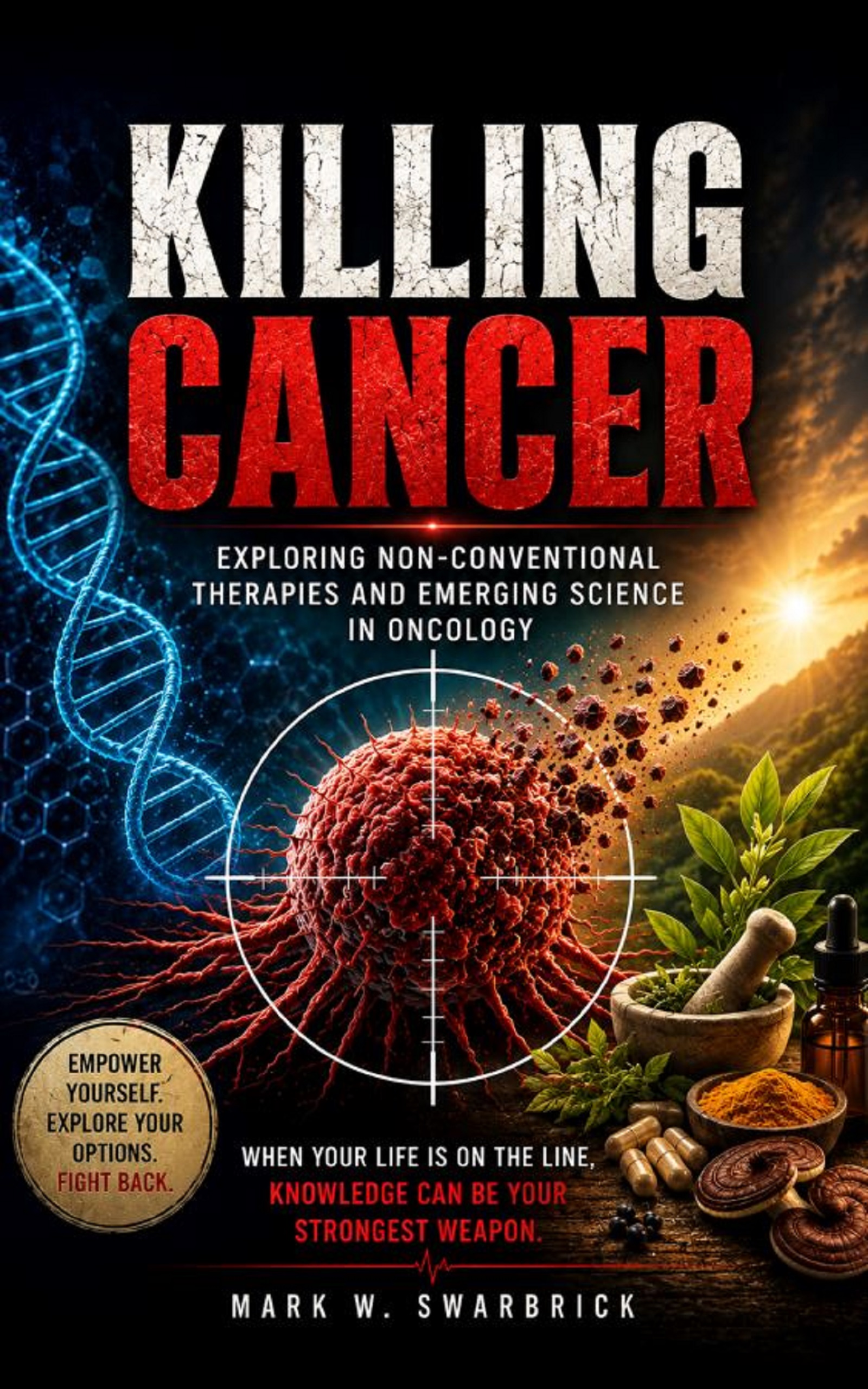
Killing Cancer: Exploring Non-Conventional Therapies and Emerging Science in Oncology
In Killing Cancer, Mark Swarbrick examines more than two dozen alternative and integrative cancer therapies, including ivermectin, fenbendazole, curcumin, fasting, ketogenic diets, medicinal mushrooms, and more, drawing on scientific research, emerging evidence, and reported recoveries.
Available in Paperback, Kindle eBook, and Audio Book. Only $3.99.
Does Ivermectin Kill Cancer Cells?
Scientific research on ivermectin and cancer goes far beyond anecdotal reports. Laboratory and animal studies have found anticancer activity across numerous cancer types, including breast, prostate, colorectal and lung cancers, as well as leukemia. Researchers have reported that ivermectin can inhibit cancer-cell growth, reduce tumor size in animal models and, in some studies, make cancer cells more susceptible to other treatments. Pasted text
What makes ivermectin particularly interesting is that it appears to attack cancer through several different mechanisms. Studies have found that it can trigger apoptosis—the process that causes damaged or abnormal cells to self-destruct—and interfere with signaling pathways cancer cells use to grow and survive. Research also indicates that ivermectin can disrupt cancer-cell metabolism, increase destructive oxidative stress within cancer cells, affect cancer stem cells and alter the tumor environment in ways that may make cancer more vulnerable to the immune system. Pasted text
Ivermectin may also work alongside established cancer treatments. Some studies have found that it can make resistant cancer cells more responsive to chemotherapy and radiation. Taken together, the evidence presents an intriguing picture: ivermectin has demonstrated measurable anticancer activity through multiple biological mechanisms and across multiple forms of cancer, making it far more than an Internet rumor that began with Mel Gibson and Joe Rogan. Pasted text
Is Ivermectin Safe?
Ivermectin is hardly a new or experimental drug. It has been used in human medicine for decades, is included on the World Health Organization’s Model List of Essential Medicines, and billions of doses have been distributed worldwide. Pasted text It has such a well-established safety record that a growing number of states have passed laws allowing people to obtain human ivermectin without an individual prescription, including Tennessee, Arkansas, Idaho, Louisiana, Texas, and Missouri. Its decades-long history of widespread human use gives ivermectin an exceptionally strong safety record.
What About Fenbendazole and Cancer?
Fenbendazole, often called “FenBen,” is an inexpensive antiparasitic drug primarily used in veterinary medicine. It is closely related to mebendazole, a drug approved for human use, and both appear to attack cancer through many of the same mechanisms. Researchers have found that these drugs can disrupt microtubules that cancer cells need to divide, trigger programmed cell death, interfere with cellular metabolism, increase oxidative stress, inhibit the formation of blood vessels that feed tumors, and potentially reduce cancer-cell migration and spread. Pasted text Pasted text
The story that brought fenbendazole widespread attention was that of Joe Tippens. In 2017, Tippens had small-cell lung cancer that had spread throughout his body. He reported cancer in his neck, lung, stomach, liver, bladder, pancreas, tailbone and elsewhere, with a life expectancy of about three months. After a veterinarian friend told him about fenbendazole research involving cancer, Tippens began taking the drug along with curcumin and CBD oil while also participating in a clinical trial. A few months later, his PET scan showed no evidence of cancer. Most remarkably, according to Tippens, his oncologist told him that he was the only patient in that clinical trial to experience that kind of response. Tippens subsequently reported continuing to receive cancer-free scans, and according to his account, he remains cancer-free today. Pasted text
Fenbendazole itself has not undergone human cancer clinical trials because it is a veterinary drug, but its close relative mebendazole has reached early-stage human trials. Meanwhile, laboratory and animal research has continued to demonstrate anticancer activity from this family of drugs. Pasted text The Tippens story is therefore not the only reason fenbendazole has attracted attention: there are identifiable biological mechanisms and a substantial body of laboratory research behind the interest.
Cancer Patients Are Reporting Success With Ivermectin and Fenbendazole
Mel Gibson’s three friends are far from the only people reporting remarkable results. Across the Internet, cancer patients and their families have described tumor regression, remission and diagnoses of no evidence of disease after using ivermectin, fenbendazole or combinations of the two. Entire online communities have developed around these treatments, and physicians such as Dr. William Makis have collected numerous patient accounts involving ivermectin and fenbendazole cancer protocols. Pasted text
In Killing Cancer, I include several examples. One man reported using ivermectin and fenbendazole as the foundation of his treatment for bladder cancer and, after three months, receiving a finding of no evidence of disease. Another woman reported that her husband had stage-three-plus colorectal cancer, began taking ivermectin, and was subsequently found to be cancer-free. These reports do not stand alone, but are part of a much larger collection of similar accounts from cancer patients. Pasted text
Anecdotal evidence should not simply be dismissed because it is anecdotal. Medicine has long used unusual patient outcomes to identify patterns, generate hypotheses and point researchers toward treatments worthy of further investigation. When laboratory research is already demonstrating anticancer activity and patients are independently reporting remarkable outcomes, those reports provide another reason to investigate ivermectin and fenbendazole seriously rather than simply waving them away as stories. Pasted text
A 2026 Study of Ivermectin and Mebendazole in Cancer Patients
The ivermectin cancer debate became even more interesting in 2026. Researchers published a prospective observational study involving 197 cancer patients who were prescribed ivermectin together with mebendazole, another antiparasitic drug related to fenbendazole. Of those patients, 122 completed the six-month follow-up. The reported results attracted considerable attention. Among the patients who completed follow-up, 32.8 percent reported no evidence of disease and another 15.6 percent reported tumor regression. An additional 36.1 percent reported stable disease. The researchers calculated what they called a clinical benefit ratio of 84.4 percent.
I examine ivermectin, fenbendazole and other controversial approaches to cancer much more extensively in my book, Killing Cancer. The purpose is not to tell cancer patients to abandon their doctors or proven treatments. It is to examine evidence, ideas and potential approaches that deserve an honest hearing in the continuing search for better ways to fight one of humanity’s most devastating diseases.
Killing Cancer: Exploring Non-Conventional Therapies and Emerging Science in Oncology
In Killing Cancer, Mark Swarbrick examines more than two dozen alternative and integrative cancer therapies, including ivermectin, fenbendazole, curcumin, fasting, ketogenic diets, medicinal mushrooms, and more, drawing on scientific research, emerging evidence, and reported recoveries.
Available in Paperback, Kindle eBook, and Audio Book. Only $3.99.
Medical Disclaimer
The information in this article is provided for educational and informational purposes only and is not intended as medical advice, diagnosis, or treatment. Cancer is a serious medical condition, and treatment decisions should be made in consultation with a qualified healthcare professional. Do not begin, discontinue, or change any medication or cancer treatment based solely on information presented in this article.


 Global Warming: Socialism in Disguise